The plant
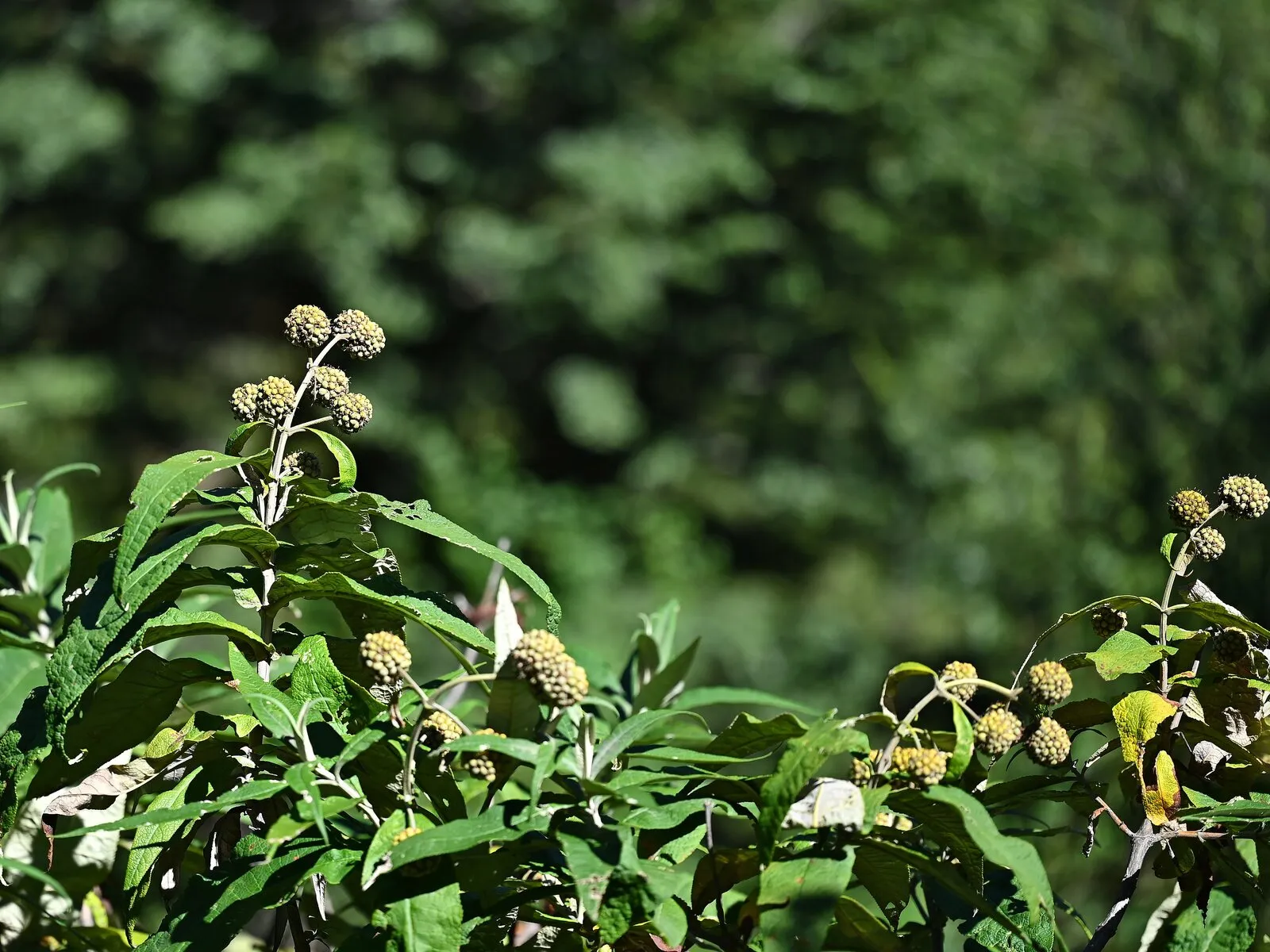
A tall evergreen shrub of the Chilean Andes with wrinkled grey-green leaves and round, honey-scented heads of orange flowers.
Names
The scientific name is Buddleja globosa Hope. John Hope, professor of botany in Edinburgh, described the species in 1782 from plants that had reached Britain from Chile a few years earlier. The genus honours the English botanist Adam Buddle; globosa describes the ball-shaped flower heads.
In Chile the plant is matico or pañil. In Mapudungun, the language of the Mapuche, it is pañil, palñin or palnguiñ, a name glossed as “shrub that grows in a sunny place” (Becerra et al. 2026). In Quechua-speaking regions it is palguín (Fuentes-Barros et al. 2026). English gardeners call it the orange-ball tree or orange-ball buddleja; in German it is the Kugel-Sommerflieder.
The name matico is also used in Peru for Piper aduncum, a pepper relative with no connection to this plant. When a paper, a shop or a recipe says “matico”, it is worth checking which plant is meant.
Family
Buddleja is a genus of about 100 trees and shrubs of the tropics and subtropics of America, Africa and Asia. The genus was long placed in its own family, Buddlejaceae, and before that in the Loganiaceae. Molecular work has moved it into the figwort family, Scrophulariaceae, which is where current floras put it. Older and even some recent papers still write “Buddlejaceae”. Buddleja globosa is the only Buddleja native to Chile with a systematic tradition of medicinal use (Pastene-Navarrete & Torres-Vega 2021).
Description
Matico is an evergreen or semi-evergreen shrub that reaches 3 to 5 m. The trunk is slender and soft, branches freely, and sends up many suckers from the base, which is why the plant regrows after cutting (Vogel et al. 2011).
- Leaves. Opposite, almost stalkless, lanceolate to elliptic, 3 to 15 cm long and 1 to 5 cm wide, with a pointed tip and finely toothed margin. The upper surface is dark green and rough, with the veins deeply impressed. The lower surface is covered in a dense felt of yellowish white hairs, as are the young shoots (Becerra et al. 2026).
- Flower heads. The flowers sit in dense globose heads 1 to 2 cm across, arranged several to a stalk at the ends of the branches. Each head holds dozens of small tubular flowers, yellow to deep orange, sometimes with a red throat. The heads smell strongly of honey.
- Fruit. A small capsule with many tiny angular seeds.
- Sex of the plants. Sources disagree. One 2026 review describes the flowers as hermaphrodite (Fuentes-Barros et al. 2026), another calls the shrub dioecious, with male and female plants (Becerra et al. 2026). Several New World Buddleja species are functionally dioecious, so the question deserves a closer look.
Where it grows
Matico is native to Chile, with records from neighbouring countries. It occurs from the Valparaíso Region at about 32°S to the Los Lagos Region at about 44°S. It grows at low altitude in the interior valleys and between 500 and 2,000 m in the Coastal Range (Pastene-Navarrete & Torres-Vega 2021). It favours river banks, gullies, forest edges and other moist, open places, and it is common around Santiago and throughout central and southern Chile (Fuentes-Barros et al. 2026).
Seasons
Populations in the valleys flower early, from September to November. Populations in the mountains are held back by the cold and flower in December or January. Valley plants grow for about eight months of the year and rest for four; mountain plants grow for only about six months (Wilckens et al. 2013). In European gardens the shrub flowers in May and June.
Pressure on wild plants
Most matico leaf sold in Chile has been gathered from wild plants, and the plant does not cope equally well everywhere. After pruning, valley plants regrow about 11 percent of their biomass within the study period, Andean plants only about 2 percent. A valley plant yields on average about 450 g of dry leaf, an Andean plant about 25 g. Cutting the plant at the base is especially damaging. The authors therefore recommend topping the shoots by hand, about 15 cm in winter and 40 cm in summer, with winter harvests in the lowlands and summer harvests in the mountains (Wilckens et al. 2013). Bringing the species into cultivation is the other answer, and it is described on the cultivation page.
Relatives and look-alikes
Among the species grown in gardens, the hybrid Buddleja × weyeriana has matico as one parent and B. davidii as the other, and shows round heads in loose panicles. The other South American species that reaches gardens, B. araucana, has smaller, paler heads.